QCVN 123:2024/BGTVT
NATIONAL TECHNICAL REGULATION ON CHILD RESTRAINT SYSTEMS USED IN MOTOR VEHICLE
PREFACE
QCVN 123:2024/BGTVT is drafted by the Vietnam Register, proposed by Science - Technology and Environment Department, appraised by the Ministry of Science and Technology, and promulgated by the Minister of Transport together with Circular No. 48/2024/TT-BGTVT dated November 15, 2024.
QCVN 123:2024/BGTVT is an adaptation of UN Regulation No. 44, revision 3, Amendment 11 and UN Regulation No. 129, Amendment 12.
NATIONAL TECHNICAL REGULATION ON CHILD RESTRAINT SYSTEMS USED IN MOTOR VEHICLE
1. GENERAL PROVISIONS
1.1. Scope
This Regulation prescribes requirements for testing and conformity assessment of child restraint systems.
1.2. Regulated entities
This Regulation applies to manufacturers, assemblers, importers of child restraint systems; automobile manufacturers and assemblers; and organizations and individuals involved in conformity assessment of child restraint systems.
1.3. Definitions
For the purposes of this Regulation, the terms below shall be construed as follows:
1.3.1. Child restraint system: A system intended to secure a child in a sitting or lying position in an automobile, designed to reduce the risk of injury to the occupant in the event of a collision or sudden deceleration by limiting the movement of the child’s body. Child restraint systems include Child Restraint Systems (CRS) and Enhanced Child Restraint Systems (ECRS).
1.3.2. Child Restraint Systems (CRS) means an arrangement of components including seat, straps, securing buckle, adjusting devices and attachments such as infant carrier, impact shield, capable of being anchored to the automobile.
1.3.3. Enhanced Child Restraint Systems (ECRS) include Integral Universal ISOFIX Child Restraint Systems - i-Size, and Integral "Specific vehicle ISOFIX" Child Restraint Systems.
1.3.3.1. Integral Universal ISOFIX Child Restraint System (i-Size) is a CRS suitable for use in any i Size seating position of the vehicle.
1.3.3.2. Integral "Specific vehicle ISOFIX" Child Restraint System is a CRS suitable for use in a particular vehicle type.
1.3.4. CRS fall into 5 mass groups:
1.3.4.1. Group 0 for children of a mass less than 10 kg;
1.3.4.2. Group 0+ for children of a mass less than 13 kg;
1.3.4.3. Group I for children of a mass from 9 kg to 18 kg;
1.3.4.4. Group II for children of a mass from 15 kg to 25 kg;
1.3.4.5. Group III for children of a mass from 22 kg to 36 kg;
1.3.5. CRS fall into 4 categories:
1.3.5.1. Universal category, for use on most vehicle seat positions.
1.3.5.2. Restricted category, for use in designated seat positions for particular vehicle types as indicated by either the child restraint manufacturer or the vehicle manufacturer.
1.3.5.3. Semi-universal category.
1.3.5.4. Specific vehicle category, for use on specific vehicle types; or as a built-in CRS.
1.3.6. ISOFIX is a system for the connection of child restraint systems to vehicles which has 2 vehicle rigid anchorages, 2 corresponding rigid attachments on the child restraint system and a mean to limit the pitch rotation of the child restraint system.
1.3.7. ISOFIX universal is an ISOFIX system equipped with a top tether or support leg as an anti-rotation device for the CRS
1.3.8. ISOFIX child restraint system is a CRS suitable for attached to the ISOFIX anchorage system on the vehicle.
ISOFIX child restraint systems fall into 7 ISOFIX size classes:
A - ISO/F3: Full Height Forward Facing toddler CRS;
B - ISO/F2: Reduced Height Forward Facing toddler CRS;
B1 - ISO/F2X: Reduced Height Forward Facing toddler CRS;
C - ISO/R3: Full Size Rearward Facing toddler CRS;
D - ISO/R2: Reduced Size Rearward Facing toddler CRS;
E - ISO/R1: Rearward Facing infant CRS;
F - ISO/L1: Left Lateral Facing position CRS (carry-cot);
G - ISO/L2: Right Lateral Facing position CRS (carry-cot).
Table 1 - ISOFIX CRS classes
Mass group | ISOFIX class | ISOFIX attachment |
0 - up to 10 kg | F | ISO/L1 |
G | ISO/L2 | |
E | ISO/R1 | |
0+- up to 13 kg | C | ISO/R3 |
D | ISO/R2 | |
E | ISO/R1 | |
I - 9 kg to 18 kg | A | ISO/F3 |
B | ISO/F2 | |
B1 | ISO/F2X | |
C | ISO/R3 | |
D | ISO/R2 |
1.3.9. Orientation indicates the orientation of the CRS used:
1.3.9.1. Forward-facing means facing in the normal direction of travel of the vehicle;
1.3.9.2. Rearward-facing means facing in the direction opposite to the normal direction of travel of the vehicle;
1.3.9.3. Lateral-facing means facing in the direction perpendicular to the normal direction of travel of the vehicle;
1.3.10. Inclined position means a special position of the chair which allows the child to recline.
1.3.11. Lying down/supine/prone position means a position where at least the child's head and body excluding its limbs are on a horizontal surface when at rest in the restraint.
1.3.12. Special Needs Restraint is a child restraint system designed for children who have special needs as a result of either a physical or mental handicap; this device may in particular permit additional restraining devices for any part of the child, but it must contain as a minimum a primary means of restraint which complies with the requirements of this Regulation.
1.3.13. Child-safety chair means a child restraint incorporating a chair in which the child is held.
1.3.14. Belt means a child restraint comprising a combination of straps with a securing buckle, adjusting devices and attachments.
1.3.15. Chair means a constituent part of the child restraint and is intended to accommodate a child in a seated position.
1.3.16. Carry cot means a restraint system intended to accommodate and restrain the child in a supine or prone position with the child's spine perpendicular to the median longitudinal plane of the vehicle. It is so designed as to distribute the restraining forces over the child's head and body in the event of a collision.
1.3.17. Infant carrier means a restraint system intended to accommodate the child in a rearward-facing semi-recumbent position. It is so designed as to distribute the restraining forces over the child's head and body in the event of a frontal collision.
1.3.18. Chair support means that part of a child restraint by which the chair can be raised.
1.3.19. Child support means that part of a child restraint by which the child can be raised within the child restraint.
1.3.20. Impact shield means a device secured in front of the child and designed to distribute the restraining forces over the child's upper body in the event of a frontal impact.
1.3.21. Strap means a flexible component designed to transmit forces.
1.3.21.1. Lap strap means a strap which, either in the form of a complete belt or in the form of a component of such a belt, passes across the front of the child's pelvic region.
1.3.21.2. Shoulder restraint means that part of a belt which restrains the child's upper torso.
1.3.21.3. Crotch strap means a strap attached to the child restraint and the lap strap and is so positioned as to pass between the child's thighs to prevent the child sliding under the lap belt in normal use and prevent the lap belt moving up off the pelvis in an impact.
1.3.21.4. Child-restraining strap means a strap which is a constituent part of the belt and restrains only the body of the child.
1.3.21.5. Harness belt means a belt assembly comprising a lap belt, shoulder restraints and, where fitted, a crotch strap.
1.3.21.6. Y-shaped belt means a belt where the combination of straps is formed by a strap to be guided between the child's legs and a strap for each shoulder.
1.3.22. Child-restraint attachment strap means a strap which attaches the child restraint to the structure of the vehicle.
1.3.23. Buckle means a quick release device which enables the child to be held by the restraint or the restraint by the structure of the vehicle and can be quickly opened. The buckle may incorporate the adjusting device.
1.3.23.1. Enclosed buckle release button means a buckle release button such that it must not be possible to release the buckle using a sphere having a diameter of 40 mm.
1.3.23.2. Non-enclosed buckle release button means a buckle release button such that it must be possible to release the buckle using a sphere having a diameter of 40 mm.
1.3.24. CRS type means child restraint systems which do not differ in terms of:
1.3.24.1. Category, mass group defined in 1.3.4 and installation instructions in 1.3.9.1 and 1.3.9.2.
1.3.24.2. The geometry of the child restraint;
1.3.24.3. The dimensions, mass, material and color of the seat, the padding, and the impact shield.
1.3.24.4. The material and dimensions of the straps;
1.3.24.5. Rigid components such as: buckle, attachments.
1.3.25. ECRS type means enhanced child restraint systems which do not differ in terms of:
1.3.25.1. The ECRS type approved;
1.3.25.2. The design, material and structure of the ECRS.
1.3.25.3. The modular or convertible ECRS do not differ in terms of design, materials and structures.
2. TECHNICAL PROVISIONS
2.1. General provisions
2.1.1 General provisions for CRS
2.1.1.1. Child restraint systems must be suitable for installation on vehicles.
2.1.1.2. There must be no sharp edges or protrusions liable to cause damage to vehicle-seat covers or to occupant's clothing.
2.1.1.3. Its rigid parts do not, exhibit sharp edges capable of abrading the straps at points where they are in contact with straps.
2.1.1.4. Any part of the CRS shall be designed to be inseparable or unable to be separated without special tools. Any part made separable to enable components to be fixed or adjusted shall be so designed as to avoid any risk of incorrect assembly and use.
2.1.2. Warning labels
2.1.2.1. When a CRS is used with the adult seat belt, the correct belt routing must be shown by a fixed pictogram on the CRS. Belt routing must be color‑coded: red for forward‑facing routing in red, blue for rearward‑facing routing. CRS that can be installed both forward and rearward without changing belt routing (e.g. rotating seats) must display both colors. All pictograms must show the CRS orientation relative to the vehicle.
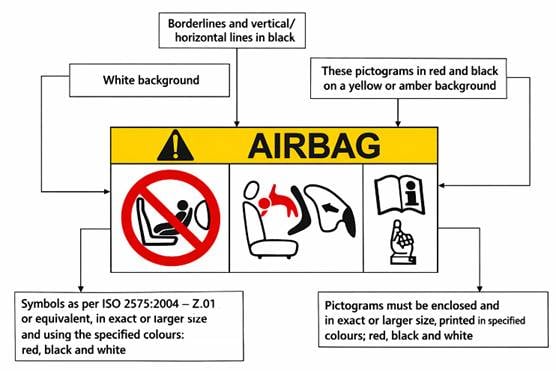
2.1.2.2. On the visible inner surface near the child’s head of rearward‑facing CRS, there must be a fixed label with the following information:
2. 1.2.2.1. Minimum overall label size: 120 mm × 60 mm or equal area;
2. 1.2.2.2. The layout of the label may vary but its content must be conformable. Barcode or identification mark up to 8 mm × 35 mm may be added to the label;
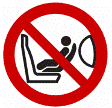
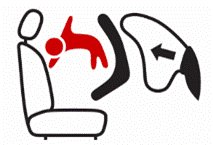
2. 1.2.2.3. Pictograms provided must not be altered in shape or orientation except for a small change to the finger pointing to open book with "i" symbol on the right page, as long as it is still recognizable;
2. 1.2.2.4. Minor deviations such as line thickness, label printing and production tolerances are acceptable;
2. 1.2.2.5. Labels must be sewn around the perimeter or otherwise permanently affixed. Labels resembling national flags are prohibited;
2. 1.2.2.6. If a label is obscured by CRS parts or accessories, an additional label must be placed in a noticeable position.
2. Figure 1 - Warning label on the CRS
2. Figure 2 - This pictogram in ISO 2575:2004 - Z.01 must be used with a circle with outer diameter not shorter than 38 mm
2. Figure 3 - Air bag deployment warning pictogram with length of 40 mm and height of 28 mm or more with the same ratio
2.1.2.3. In the case the CRS can be used forward and rear-facing, include the text: “IMPORTANT - DO NOT USE FORWARD FACING BEFORE THE CHILD'S WEIGHT EXCEEDS .......... (Refer to instructions)" or Vietnamese text with the same meaning.
2.1.2.4. In the case of a CRS with alternative belt routes, the alternative load bearing contact points between the CRS and the adult safety-belt must be permanently marked. This marking shall indicate that it is the alternative belt route, and shall conform with the above coding requirements.
2.1.2.5. If the CRS offers alternative load bearing contact points, the marking required in paragraph 2.1.2.3 shall include an indication that the alternative belt route is described in the instructions.
2.1.2.6. ISOFIX marking
If the product includes ISOFIX attachments, the following information must be included:
2. 1.2.6.1. The ISO ISOFIX logo followed by the letters that are appropriate for the ISOFIX size classes into which the product fits. As a minimum, a symbol consisting of a circle with a minimum diameter of 13 mm and containing a pictogram. The pictogram shall be clearly visible either by contrast colors or by relief if it is molded or embossed.
2. Figure 4- ISOFIX logo
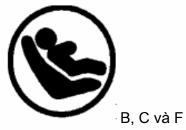
2. 1.2.6.2. The following information must be conveyed by pictograms or text.
2. 1.2.6.2.1. The essential relevant steps for seat installation. For example, the method of extending the ISOFIX latch system must be explained.
2. 1.2.6.2.2. The position, function, and interpretation of any indicator must be explained;
2. 1.2.6.2.3. The position and the routing of top tether (if necessary) or other means of limiting seat rotation must be indicated using one of the following symbols:
2. Figure 5 - Instructions for installation of anti-rotation device on the CRS
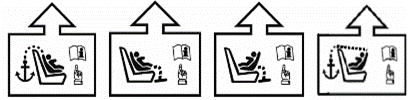
2. 1.2.6.2.4. The adjustment of ISOFIX latches and the top tether or other means of limiting seat rotation requiring action of the user must be indicated;
2. 1.2.6.2.5. The marking must be permanently attached and be visible to a user installing the CRS.
2. 1.2.6.2.6. Where necessary, reference should be made to the child restraint user instructions and to the location of that document using the symbol below.
2. Figure 6 - Symbol of the user instructions manual

2.1.2.7. Backless booster seat label
For backless booster seats, a rear label must be permanently affixed in a position visible to the installer and will be covered when a high‑back booster is used.
2.1.2.7. Figure 7 - Backless booster seat label
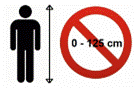
2.1.3. Warning labels for enhanced child restraint systems (ECRS)
2.1.3.1. The orientation of an ECRS relative to the vehicle must be clearly marked on the seat.
2.1.3.2. On the inner surface of rearward‑facing ECRS (including head side wings) near the child’s head, a permanently affixed label must include the following information:
2.1.3.2. Figure 8 - Warning label on the ECRS
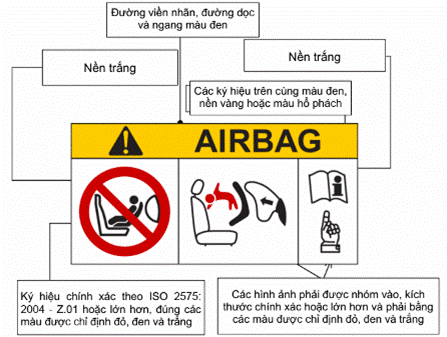
2. 1.3.2.1. Minimum overall label size: 60 mm × 120 mm
2. 1.3.2.2. Labels must be sewn around the perimeter or otherwise permanently affixed. Labels resembling national flags are prohibited;
2. 1.3.2.3. If a label is obscured by ECRS parts or accessories provided by the ECRS manufacturer, an additional label must be placed in a visible position.
2.1.3.3. In the case the ECRS can be used forward-facing and rear-facing, the label below must be permanently affixed where it is noticeable. Minimum dimension: 40 mm x 40 mm.
2.1.3.3. Figure 9 - Warning label on the ECRS that can be used both forward-facing and rear-facing
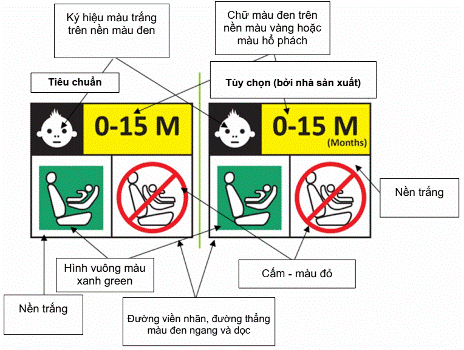
2.1.3.4. In the case the ECRS can be only be used forward-facing, the label below must be permanently affixed where it is noticeable. Minimum dimension: 40 mm x 40 mm.
2.1.3.4. Figure 10 - Warning label on the ECRS that can only be used forward-facing
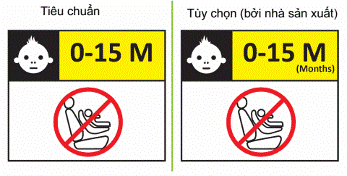
2.1.3.5. i-Size label
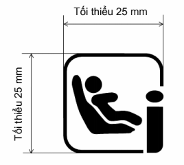
2. 1.3.5.1. The i-Size logo below shall have minimum dimension of 25 mm x 25 mm, contrast with the background. The pictogram shall be clearly visible either by contrast colors or by relief if it is molded or embossed.
2. Figure 11- i-Size logo
2. 1.3.5.2. Dimensions of the CRS shall be expressed as centimeter (cm);
2. 1.3.5.3. The maximum permissible child mass shall be express as kilogram (kg).
2.1.3.6. Labels of "Specific vehicle ISOFIX" child restraint systems
Specific vehicle ISOFIX" child restraint systems shall have permanently affixed labels where they are noticeable with the text "SPECIFIC VEHICLE ISOFIX" or Vietnamese text with the same meaning.
2.1.3.7. The following information must be conveyed by pictograms or text.
2. 1.3.7.1. The essential relevant steps for seat installation. For example, the method of extending the ISOFIX latch system must be explained.
2. 1.3.7.2. The position, function, and interpretation of any indicator must be explained;
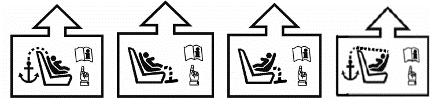
2. 1.3.7.3. The position and the routing of top tether (if necessary) or other means of limiting seat rotation must be indicated using one of the following symbols:
2. Figure 12 - Instructions for installation of anti-rotation device on the ECRS
2. 1.3.7.4. The adjustment of ISOFIX latches and the top tether or other means of limiting seat rotation requiring action of the user must be indicated;
2. 1.3.7.5. The marking must be permanently attached and be visible to a user installing the ECRS;
2. 1.3.7.6. Where necessary, reference should be made to the child restraint user instructions and to the location of that document using the symbol below.
2. Figure 13 - Symbol of the user instructions

2.2. Technical provisions and test methods for buckles and straps of child restraint systems
2.2.1. The buckle shall be so designed as to preclude any possibility of incorrect manipulation. Wherever the buckle is in contact with the child, it shall not be narrower than the minimum width of strap as specified in paragraph 2.2.5 below.
2.2.2. The buckle shall remain closed whatever its position even when not under tension. It shall be easy to operate and possible to be opened by pressure on a button or on a similar device.
2.2.3. When projected into a plane perpendicular to the button's initial direction of motion:
2.2.3.1. For enclosed devices, an area of not less than 4,5 cm2 with a width of not less than 15 mm;
2.2.3.2. For non-enclosed devices, an area of not less than 2,5 cm2 and a width of not less than 10 mm.
2.2.3.3. The width shall be the smaller of the two dimensions forming the button area and shall be perpendicular to the direction of movement of the release button.
2.2.4. The buckle release area shall be colored red. No other part of the buckle shall be of this color.
2.2.5. The minimum width of the CRS straps at the point of contact with the child is 25 mm.
3. ADMINISTRATIVE PROVISIONS
3.1. Product management and certification
3.1.1. Before being sold on the market, child restraint systems must have declarations of conformity in accordance with Circular No. 28/2012/TT-BKHCN dated December 12, 2012 of the Minister of Science and Technology on declaration of conformity with standards and technical regulations, and conformity assessment methods (hereinafter referred to as "Circular No. 28/2012/TT-BKHCN") and Circular No. 02/2017/TT-BKHCN dated March 31, 2017 on amendments to Circular No. 28/2012/TT- BKHCN (hereinafter referred to as "Circular No. 02/2017/TT-BKHCN").
3.1.1.1. Domestically manufactured or assembled child restraint systems must undergo conformity assessment using Method 5 prescribed in Appendix II of Circular No. 28/2012/TT-BKHCN and Circular No. 02/2017/TT-BKHCN.
3.1.1.2. Imported child restraint systems must undergo conformity assessment using Method 7 prescribed in Appendix II of Circular No. 28/2012/TT-BKHCN and Circular No. 02/2017/BKHCN.
3.1.2. Declaration of conformity
Declarations of conformity of child restraint systems shall be submitted to the Department of Transport of the province or city where the manufacturer or seller is registered on the basis of conformity certification issued by the certifying organization designated by Vietnam Register under the Government's Decree No. 132/2008/ND-CP dated December 31, 2008 elaborating some Articles of the Law on Product and Goods Quality (amended by Decree No. 74/2018/ND-CP dated May 15, 2018 and Decree No. 154/2018/ND-CP dated November 09, 2018).
3.2. Labeling requirements
3.2.1. Child restraint systems shall be labeled in accordance with the Government’s Decree No. 43/2017/ND-CP dated April 14, 2017 on goods labels and the Government’s Decree No. 111/2021/ND-CP dated December 09, 2021 on amendments to Decree No. 43/2017/ND-CP 14/4/2017.
3.2.2. Conformity markings shall comply with Circular No. 28/2012/TT-BKHCN.
4. IMPLEMENTATION ORGANIZATION
4.1. Vietnam Register shall cooperate with relevant authorities in organizing the implementation of this Regulation.
4.2. Vietnam Register shall designate conformity-assessing organizations in accordance with regulations of law on goods quality, technical regulations and standards to assess conformity of products with this Regulation for conformity declaration purposes.
4.3. In cases where any of the legal regulations and legislative documents referred to in this Regulation are amended or replaced, the newest documents shall apply./.